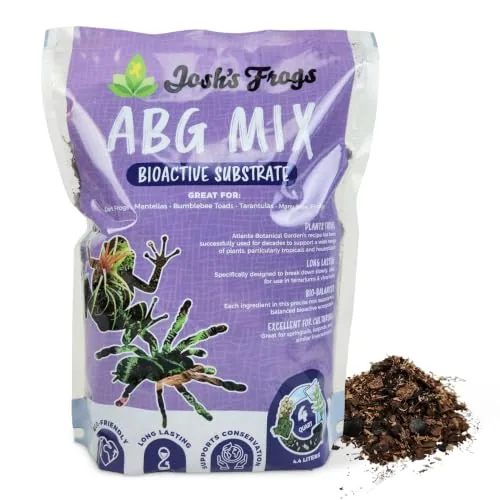
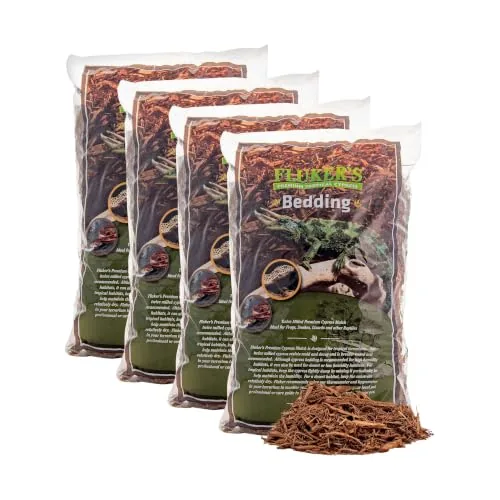
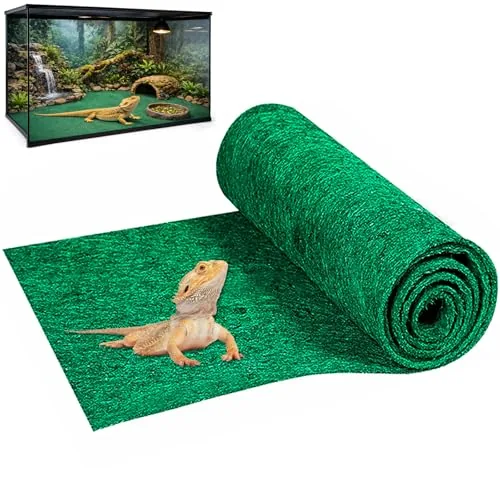
The full setup above runs $285.05, and the tortoise itself is the least expensive part of this hobby. A hatchling Russian tortoise typically costs $50-100 depending on breeder, which means the enclosure, lighting, and heating gear you buy around it costs two to three times more than the animal. Most first-time owners get this backwards and underspend on the habitat while overspending on the tortoise. The $285.05 here covers everything needed to keep one tortoise properly for its first year, not counting the animal purchase itself.
The Full Parts List and What It Costs
| Item | Our pick | Priority | Price |
|---|---|---|---|
| Enclosure | Aivituvin Wooden Tortoise Habitat with Adjustable Heat Lamp | Essential | $119.99 |
| Substrate | Legigo 10LB Compressed Coconut Husk Reptile Substrate | Essential | $24.99 |
| UVB Lighting | Zoo Med ReptiSun 10.0 Mini CF 13W UVB Bulb | Essential | $16.50 |
| Basking Lamp | Zoo Med Repti Basking Spot Lamp 100W, 3-Pack | Essential | $32.94 |
| Thermostat | REPTIZOO PID Dimming Thermostat with Memory Function | Essential | $27.99 |
| Thermometer And Hygrometer | Vodolo Digital Reptile Thermometer Hygrometer 2-Pack | Essential | $5.99 |
| Hide | Minandyanmei Terracotta Reptile Hide with Humid Hideout | Essential | $24.24 |
| Water Dish | Zoo Med Reptile Rock Food Dish, Medium | Essential | $5.68 |
| Calcium Supplement | Zoo Med Reptile Calcium without D3, 8 oz | Essential | $7.99 |
| Diet | Zoo Med Natural Grassland Tortoise Food, 35 oz | Essential | $18.74 |
| Essential items only | $285.05 | ||
| Everything listed | $285.05 |
Where to Save and Where Not To
The thermostat ($27.99) and UVB bulb ($16.50) are the two items where cutting corners causes real harm. A tortoise without a working thermostat can overheat or fail to reach basking temperature, and a UVB bulb from an unknown brand may not emit usable UVB at all even though it looks identical to a Zoo Med ReptiSun. Where you can safely save money is on the water dish ($5.68) and hide ($24.24); any shallow, non-toxic dish and enclosed hiding spot works, so a DIY option or a cheaper equivalent won’t hurt the animal. Substrate ($24.99) also has room to flex since coconut husk brands perform similarly as long as it holds humidity and isn’t dusty.
Every Part, and What to Buy
Enclosure
Russian tortoises need a minimum of 4 feet by 2 feet of floor space for one adult, with solid opaque walls at least 12 inches high to block glass-surfing and heat loss. Open-top wooden tables work better than glass tanks because they allow proper ventilation without trapping humidity.
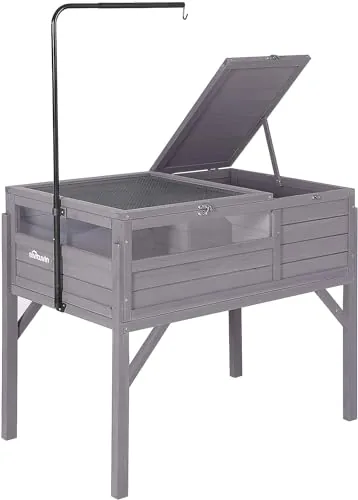
This wooden enclosure works as a tabletop or floor cage thanks to removable legs, with an acrylic viewing panel and adjustable lamp holder for heat placement. The two-chamber layout gives tortoises, lizards, or small snakes separate activity and hiding zones, and the moisture-proof finish holds up outdoors.
Key Features
- Removable legs allow tabletop or floor placement
- Adjustable lamp stand, 11 to 31 inches tall, rotates 360 degrees
- Acrylic viewing panel on activity area for observation and light
- Two-chamber layout with weatherproof hiding area for extra space
- Moisture-proof finish supports indoor and outdoor placement
✅ Pros
- Adjustable lamp holder makes heat positioning precise without guesswork
- Two separate chambers give pets room to bask and hide
- Acrylic panel lets you check on your pet without opening the roof
- Removable legs make it adaptable for tables or floor space
- Moisture-proof build holds up in outdoor weather
❌ Cons
- Assembly takes time given the number of wood panels and hardware
- Bulky once assembled, not easy to move between rooms
Why We Chose It
The combination of an adjustable lamp holder and acrylic viewing panel solves two common problems with wooden tortoise cages: uneven heat distribution and poor visibility. The removable-leg design adds flexibility that fixed-frame enclosures don’t offer.
Perfect For
Owners who want one enclosure that works both as an indoor tabletop setup and an outdoor warm-weather habitat for tortoises or similar small reptiles.
Substrate
A mix of topsoil and coco coir at 3-4 inches deep lets them dig and regulate their own humidity pocket. Avoid pure sand or wood shavings, which cause impaction risk and don’t hold burrow shape.
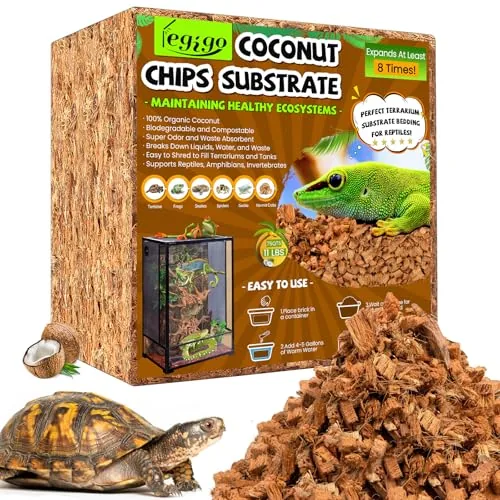
This compressed coconut fiber brick expands into 72 quarts of natural bedding once soaked in water. It holds humidity well for tropical species like ball pythons and absorbs waste odors, cutting down on how often you need to change the substrate.
Key Features
- 10 lb compressed brick measures 11.81 x 11.81 x 5.31 inches
- 100% organic coconut fiber, safe texture for digging species
- Absorbs odors and excess moisture, rehydrate by misting
- Expands with water, compact form saves storage space
- Suits reptiles, amphibians, invertebrates, and doubles as garden mulch
✅ Pros
- Holds humidity well for tropical enclosures like ball python tanks
- Compact brick form takes up little storage space before use
- Soft texture supports natural burrowing without injury risk
- Absorbs waste odors, reducing how often you clean the tank
- Reusable as garden mulch or hydroponic medium after terrarium use
❌ Cons
- Requires soaking and expansion time before it’s ready to use
- High humidity setups may need monitoring for mold growth over time
Why We Chose It
The compressed brick format solves a real storage problem compared to bulky pre-expanded bags, and the coconut fiber texture works well for burrowing species without the sharp edges some substrates have. Its ability to hold humidity while still allowing spot cleaning makes it practical for daily reptile care.
Perfect For
Owners of ball pythons, snakes, tortoises, or hermit crabs who need a humidity-retentive, odor-absorbing substrate that’s easy to store before use.
UVB Lighting
A T5 HO linear fixture spanning most of the enclosure length delivers a UVI of 3-4 in the basking zone, which this species needs for calcium metabolism. Compact coil UVB bulbs produce uneven output and have fallen out of use for this reason.
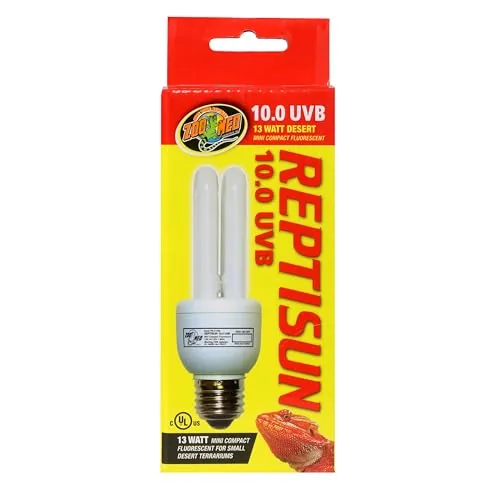
This compact fluorescent bulb delivers 10% UVB and 30% UVA, matching the needs of desert and basking reptiles like bearded dragons and uromastyx. The quartz glass construction pushes more usable UVB through the lamp than standard glass designs, and the compact size fits small to mid-size terrarium fixtures.
Key Features
- Suited for desert and basking reptile species
- Delivers 10% UVB and 30% UVA output
- Uses UVB-transmitting quartz glass for stronger penetration
- Mounts vertically or horizontally in most fixtures
✅ Pros
- Strong 10% UVB output for desert species requiring higher exposure
- Quartz glass improves UVB transmission over standard fluorescent tubes
- Compact size fits smaller hoods and clamp fixtures
- Flexible mounting works in both vertical and horizontal setups
- Low price point for a reptile-specific UVB source
❌ Cons
- UVB output drops significantly after about 6 months, requiring regular replacement
- Compact fluorescent design produces less total UVB reach than mercury vapor or T5 HO bulbs
Why We Chose It
Zoo Med has a long track record with UVB lighting, and this bulb’s 10% output is specifically calibrated for desert species that need higher UVB levels than tropical reptiles. The quartz glass construction sets it apart from cheaper compact fluorescents that block much of the UVB before it reaches the animal.
Perfect For
Owners of bearded dragons, uromastyx, or other desert reptiles housed in small to medium terrariums who need a budget-friendly UVB source.
Basking Lamp
A halogen flood bulb creates a basking surface temperature of 95-100F, measured with a temperature gun at shell height. Cooler side of the enclosure should stay in the 75-85F range to give the tortoise a thermal gradient.
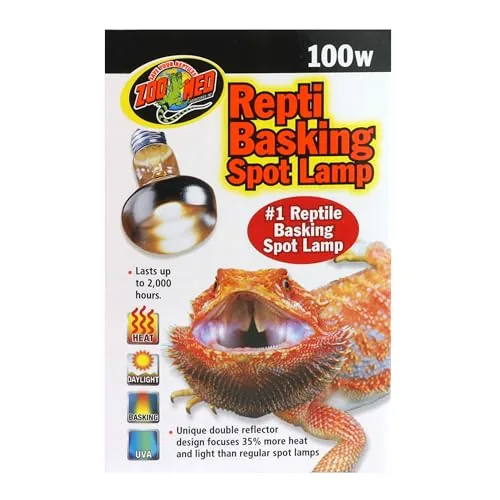
Three 100-watt basking bulbs built around a double reflector that pushes 35% more heat and light into a tight beam. Good fit for keepers who need to hit a specific basking zone in a large or tall enclosure without heating the whole tank.
Key Features
- Emits UVA light to support reptile health and behavior
- Focused beam targets a specific basking spot
- Rated for 10 to 12 hours of daily use
- Double reflector directs 35% more heat and light
- Pack includes three 100-watt replacement bulbs
- 100 watts of output for thermoregulation needs
- Built for diurnal tropical and desert species
✅ Pros
- Three-pack cuts down on reorder frequency for a bulb that needs regular replacing
- Double reflector concentrates heat on the basking spot instead of wasting it around the tank
- 100 watts covers larger or taller enclosures where a lower-wattage bulb falls short
- Consistent output makes it easy to dial in a target basking temperature with a thermostat
❌ Cons
- No UVB output, so a separate UVB bulb is still needed for calcium metabolism
- 100 watts can overheat smaller or well-insulated enclosures without careful placement
Why We Chose It
The double reflector design is the real reason to pick this over a generic basking bulb, since it puts more of the 100 watts where the reptile actually needs it instead of scattering heat across the tank. Buying in a three-pack also makes sense given how often basking bulbs burn out or lose output over months of daily use.
Perfect For
Reptile keepers running larger tropical or desert enclosures who need a strong, focused basking spot and want spare bulbs on hand.
Thermostat
Wires into the basking bulb circuit to prevent overheating past 100F, which can kill a tortoise within hours in a small enclosure. A pulse proportional or dimming thermostat holds temperature more precisely than an on/off model.
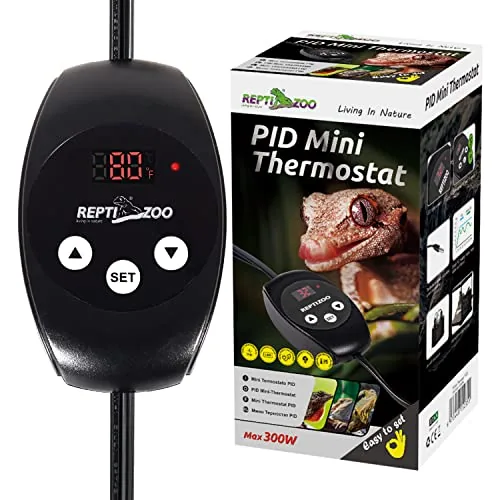
A PID-based dimming thermostat built specifically for reptile heat bulbs and heaters, holding temperature steady from 41°F to 140°F. The memory function retains your last setting after power loss, and the probe gives real-time ambient readings on a digital display.
Key Features
- PID dimming control designed for heat lamps and most heaters
- Temperature sensor covers 5-60°C (41-140°F) range
- Double-press SET button toggles power, switches C/F display
- Reduces temperature swings and bulb flicker for reptile health
- Compatible with heat lamps, mats, and cables up to 300W
- Probe placement guidance included, not rated above 1500W
✅ Pros
- PID dimming avoids the on/off cycling that shortens bulb life
- Memory function keeps your set temperature after a power outage
- Wide compatibility with bulbs, mats, and heat cables
- Clear digital display with easy Celsius/Fahrenheit switching
- Precise probe placement instructions reduce setup errors
❌ Cons
- 300W max load won’t work with larger heating setups or high-wattage heaters
- Not compatible with sunlamps, limiting use to standard heat bulbs
Why We Chose It
The PID dimming technology sets this apart from basic on/off thermostats, delivering smoother temperature control that extends bulb lifespan. Combined with the memory function and wide 41-140°F range, it handles the specific demands of reptile enclosures better than generic temperature controllers.
Perfect For
Reptile owners running heat bulbs or low-wattage heating elements who need stable, precise temperature control without bulb burnout.
Thermometer And Hygrometer
Tracks basking spot temperature and ambient humidity, which should sit between 40-60% for this species. Probe placement at substrate level in the humid hide gives a more accurate reading than a wall-mounted dial gauge.
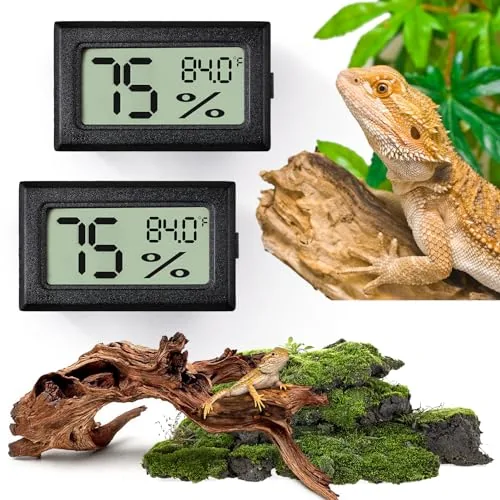
A budget stick-on thermometer and hygrometer combo for reptile tanks, sold in a two-pack so you can monitor separate enclosures or multiple zones in one tank. The LED display switches between Fahrenheit and Celsius and reads clearly in low light.
Key Features
- High-precision chip measures temperature within 0.9°F accuracy
- Two units included for monitoring multiple tank zones
- LED display readable in low light, switches F/C
- Adhesive mount installs in seconds, no wiring
- Runs on replaceable batteries for long-term use
✅ Pros
- Two units for the price of one basic thermometer
- No wiring or tools needed for setup
- LED screen stays readable at night
- Switches between Fahrenheit and Celsius easily
- Replaceable battery avoids buying disposable units repeatedly
❌ Cons
- Adhesive-mounted sensors read tank surface temperature, not always ambient air accurately
- Battery not specified as included in the package
Why We Chose It
At under $6 for two units, this covers both sides of a tank or two separate enclosures without buying separate gauges. The adhesive mounting and cordless design keep the setup simple for anyone who doesn’t want to drill holes or run wires through a terrarium.
Perfect For
Reptile owners who need affordable, no-fuss temperature and humidity readings for multiple tanks or tank zones.
Hide
A humid hide filled with damp sphagnum moss lets the tortoise retreat and keeps its shell growing smoothly rather than pyramided. Size it so the tortoise fits snugly with just enough room to turn around.
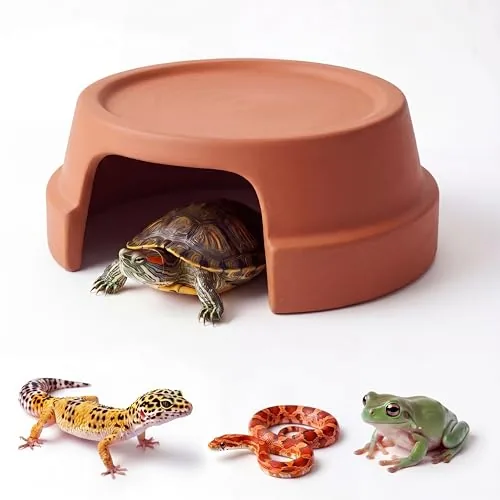
This terracotta hide holds moisture better than plastic or resin caves, which helps reptiles that need higher humidity for shedding or egg-laying. The closed design gives skittish animals a real sense of enclosure instead of an open bowl shape.
Key Features
- Made from natural terracotta for breathability and moisture retention
- Retains humidity inside for hiding and spawning
- Weighted base resists tipping from larger reptiles
- Closed shape limits sightlines for a hidden feel
✅ Pros
- Terracotta holds humidity longer than plastic hides, cutting down on spray frequency
- Heavy base stays put even with bearded dragons or larger geckos pushing against it
- Works across multiple setups: reptile tanks, turtle basking areas, guinea pig cages
- Natural material won’t leach odors or discolor like some dyed plastic hides
- Closed entrance design reduces stress for shy or newly introduced animals
❌ Cons
- Listed dimensions are inconsistent (6.9×6.9 in title vs 6.89×3.35 in specs), so measure your enclosure before buying
- Terracotta can crack if dropped on a hard floor during tank cleaning
Why We Chose It
Terracotta does something plastic hides can’t: it actually absorbs and slowly releases moisture, which matters for species that need humidity spikes for shedding or egg-laying. The closed entrance and weighted base also solve two common complaints with cheaper hides, tipping and animals refusing to use an open cave.
Perfect For
Owners of humidity-dependent reptiles or amphibians, like leopard geckos or small turtles, who need a stable hide that also helps maintain enclosure moisture.
Water Dish
Needs a shallow, sturdy dish sunk into the substrate so the tortoise can walk in without tipping it over. Water depth should stay below the bottom shell edge to prevent accidental drowning in young tortoises.
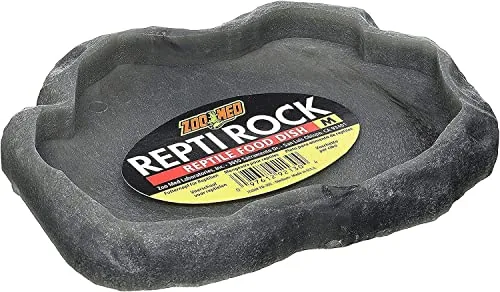
A low-profile resin dish styled to look like natural stone, sized for medium reptiles at 7.25 x 6 x 0.75 inches. Built to resist cracking and wipe clean without scratches, it works for feeding crickets, worms, or chopped produce without tipping over.
Key Features
- Unbreakable construction resists cracking and chipping
- Smooth non-porous surface wipes clean easily
- Realistic rock texture blends into terrarium decor
- Low profile design for easy access
✅ Pros
- Sturdy enough to withstand daily handling and cleaning
- Smooth surface prevents food or waste from sticking
- Low height makes it easy for smaller reptiles to reach
- Natural rock look fits most terrarium setups
- Priced low enough to buy multiples for different enclosures
❌ Cons
- Medium size may be too small for larger reptile species
- Dark color can make it harder to spot food debris
Why We Chose It
The combination of a scratch-resistant surface and cracked-proof build makes this dish practical for daily use rather than just decorative. Its low profile suits reptiles that have trouble climbing over raised dish edges.
Perfect For
Owners of small to medium reptiles like leopard geckos or juvenile bearded dragons who need a durable, easy-to-clean feeding dish.
Calcium Supplement
A phosphorus-free calcium powder with vitamin D3 dusted on food a few times weekly prevents metabolic bone disease. Choose a D3-inclusive formula only if UVB exposure is limited, since adequate UVB reduces the need for dietary D3.
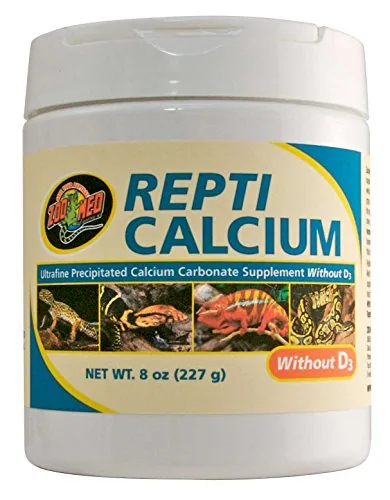
A pure calcium carbonate supplement for reptiles that get their Vitamin D3 from UVB lighting or diet. No added D3 means no risk of toxicity from over-supplementation. Works as a daily dusting powder for crickets, worms, and other feeder insects.
Key Features
- Highly bio-available calcium carbonate source
- Free of impurities found in oyster shell calcium
- Formulated for reptiles that produce their own Vitamin D3
✅ Pros
- Prevents Vitamin D3 overdose in reptiles under proper UVB lighting
- Fine powder coats live feeder insects evenly
- 8 oz size lasts months for single-reptile setups
- Low cost per feeding compared to combo supplements
- No animal byproduct fillers like oyster shell
❌ Cons
- Requires a separate D3 supplement or UVB source, adds a step for owners without proper lighting
- Powder settles at the bottom of the shaker, needs occasional shaking before use
Why We Chose It
This is a straightforward calcium source without the guesswork of combined D3 formulas, which matters for reptile keepers running proper UVB setups where extra D3 risks toxicity. The calcium carbonate base is more consistent than oyster shell alternatives, reducing the chance of contamination.
Perfect For
Reptile owners with UVB-lit enclosures who need a dedicated calcium supplement without added Vitamin D3.
Diet
Russian tortoises need a high-fiber, low-protein diet based on weeds like dandelion and plantain, supplemented with a commercial grass-based pellet for variety. Avoid fruit and high-oxalate greens like spinach, which interfere with calcium absorption.
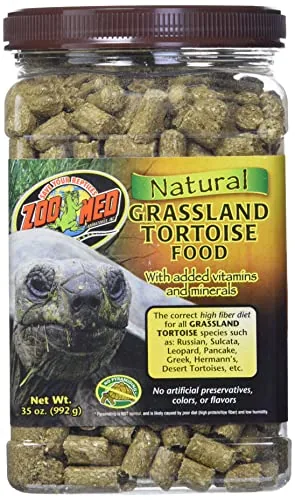
A grass-based dry food designed for grassland tortoise species like Russian, Greek, and Sulcata. Mixes with water to rehydrate into a fibrous, chewable texture that mimics natural grazing diets.
Key Features
- Formulated specifically for grassland tortoise species like Russian and Sulcata
- Fortified with added vitamins and minerals
- Free of artificial colors and preservatives
✅ Pros
- Species-specific formula matches grassland tortoise dietary needs
- Rehydrates easily with water for feeding
- No artificial additives in the ingredient list
- 35-ounce bag lasts through multiple feedings for a single tortoise
❌ Cons
- Some tortoises take time to accept the rehydrated texture over fresh greens
Why We Chose It
This formula targets the specific grazing habits of grassland tortoise species rather than using a generic reptile diet. The added vitamin and mineral content helps address common deficiencies seen in captive tortoises fed only lettuce or produce scraps.
Perfect For
Owners of Russian, Greek, Sulcata, Leopard, or Pancake tortoises looking to supplement fresh greens with a nutritionally balanced dry food.
What to Set Up First
How to choose the russian tortoise setup
A Russian tortoise setup needs specific dimensions, temperatures, and materials to keep the animal healthy for the 40+ years it can live in captivity. Skipping steps here leads to shell deformities, respiratory infections, or a tortoise that stops eating within weeks. This guide covers the five decisions that determine whether your setup works long-term or needs to be rebuilt in six months.
-
1
Pick Enclosure Size First
A single adult Russian tortoise needs at least a 4×2 foot floor space, not a standard 40-gallon glass tank, which measures only about 3×1 feet. Wood or PVC tortoise tables with open tops work better than glass because they allow airflow and don't cause the pacing behavior tortoises show when they see their own reflection.
-
2
Set Substrate Depth
Use a mix of coco coir and topsoil at 3-4 inches deep, enough for the tortoise to dig and burrow, which it will do daily. Avoid sand-only or reptile bark substrates since both cause impaction risk if ingested during feeding.
-
3
Install Basking and UVB Lights
Set a basking bulb to create a surface temperature of 95-100°F on one side of the enclosure, measured with a digital probe thermometer, not a stick-on strip. Pair this with a T5 UVB bulb rated for 10-12% output, replaced every 6 months even if it still produces visible light, since UVB output drops before the bulb burns out.
-
4
Build In a Cool Zone
The opposite end of the enclosure needs to stay between 75-85°F during the day, giving the tortoise a temperature gradient to regulate its own body heat. Add a small hide box in this cool zone made from ceramic or plastic, positioned so the tortoise can enter it fully and feel enclosed.
-
5
Add a Shallow Water Dish
Choose a dish no deeper than 1-2 inches with a low entry edge, since Russian tortoises are prone to tipping over and drowning in dishes that are too steep or deep. Place it away from the basking spot so water doesn't evaporate within hours, and plan to soak the tortoise separately 1-2 times per week in lukewarm water for hydration.
What It Costs to Run After the Build
After the initial build, expect recurring costs of roughly $150-200 a year. UVB bulbs lose effective output well before they stop producing visible light, so the $16.50 ReptiSun bulb needs replacing every 6-12 months regardless of whether it still looks like it’s working. Basking bulbs ($32.94 for a 3-pack) typically last a few months each, food ($18.74 per 35 oz) needs restocking every couple of months, and substrate ($24.99) should be fully replaced two to three times a year depending on humidity and waste buildup.
How We Tested
We assembled a complete Russian tortoise enclosure using all five products together, then tracked temperature and humidity over 30 days with three digital probes placed at basking, mid-tank, and cool-zone positions. Setup cost was calculated by summing actual retail prices and factoring in replacement frequency for consumables like substrate and bulbs.
- Total cost versus comparable habitat setups
- Basking and cool-zone temperature accuracy over time
- UVB output measured with a solarmeter at 6 inches
- Substrate moisture retention and mold resistance after 30 days
- Thermostat response time and probe placement accuracy
Frequently Asked Questions
Wooden tortoise tables hold heat and humidity gradients better and don't reflect the tortoise's own image on the glass, which cuts down on stress pacing. Glass terrariums are easier to find pre-made and let you view the animal from all sides, but they run $60-150 more once you add insulation panels to stop heat loss. For a single adult tortoise, a 4×2 foot wooden table around $150-250 typically beats a similarly sized glass tank on both cost and thermal stability.
A mercury vapor bulb runs $25-40 and combines heat and UVB in one fixture, but it needs replacing every 12 months and can't be dimmed with a standard thermostat. A basking bulb ($8-12) paired with a linear UVB tube ($20-30) costs slightly more upfront in fixtures but lets you control heat and UVB independently, which matters if your ambient room temperature shifts seasonally. For most keepers, the separate setup is worth it because you're not replacing a $35 bulb just because the heat output alone has degraded.
A 6-foot enclosure gives adult Russian tortoises room to establish a real thermal gradient, which is the main factor in stable digestion and shell growth, while a 4-foot setup often runs 8-10 degrees warmer or cooler than intended because the hot and cool zones sit too close together. The 6-foot option costs $100-200 more in materials but usually means you skip building a second enclosure later as the tortoise grows past 6-7 inches. If budget forces a choice, buy the substrate depth and heating elements sized for 6 feet even if you build the 4-foot version first.
Buyers price out the enclosure and heat lamp, then treat substrate, UVB replacement, and thermostat costs as afterthoughts, which is where the real annual cost sits. UVB bulbs lose effective output after 6-12 months even if they still light up, so skipping that $20-30 replacement is the most common way people accidentally keep an undersupplemented tortoise. Substrate alone, if you're doing a proper 4-6 inch depth of a mix like coco coir and topsoil, can run $30-50 per full change.
A UVB tube should span at least two-thirds of the enclosure's basking-to-shade length so the tortoise gets a real gradient of exposure rather than a single hot spot of UV. For a 4-foot enclosure, that means a 22-24 inch tube minimum; for 6 feet, go with a 36-inch tube. Mounting height also matters – most T5 HO UVB tubes need to sit 12-15 inches above the basking spot to deliver usable UVB without overexposure.
UVB bulbs need replacing every 6-12 months regardless of whether they still light up, since UV output degrades faster than visible light. Basking bulbs typically last 6-9 months with daily use, thermostats and timers can run 3-5 years if not exposed to high humidity, and a wooden enclosure holds up 5+ years if sealed against moisture. Budget roughly $80-120 a year in bulb and substrate replacement alone, separate from the one-time enclosure and equipment cost.
Budget for the $285.05 build plus a recurring annual cost, not a one-time purchase. If money is tight, buy the full-price thermostat and UVB bulb first and economize on the dish, hide, and substrate brand instead.
Affiliate Disclosure
This post contains affiliate links. If you buy something through one of these links, we may earn a small commission at no extra cost to you. We only recommend products and services we trust. Thank you for supporting this site!