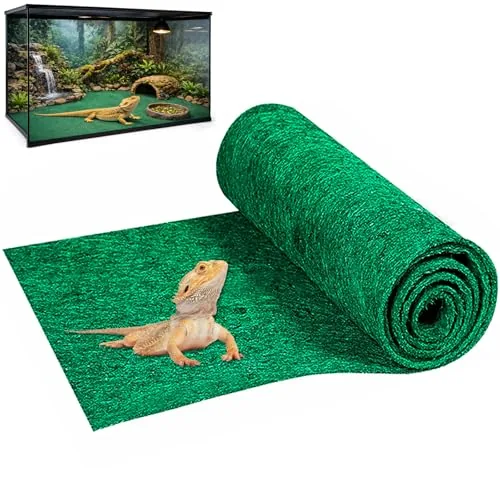
A veiled chameleon setup runs $352.35 for everything on this list, and the chameleon itself is usually the cheapest line item you’ll buy, often $20 to $40 from a breeder. The enclosure alone is $129.99, more than a third of the total budget, because veiled chameleons need height and airflow that a standard glass tank can’t give them. Lighting and climate control (UVB hood, basking bulb, thermostat, thermometer/hygrometer) add another $120.46 on top of that. This is a bioactive, climate-controlled habitat build, not a cage-and-a-lamp setup.
The Full Parts List and What It Costs
| Item | Our pick | Priority | Price |
|---|---|---|---|
| Enclosure | Zoo Med ReptiBreeze Screen Cage, 18x18x36 Large | Essential | $129.99 |
| Uvb Lighting | Zoo Med 14″ T5-HO Terrarium Hood with UVB Lamp | Essential | $59.98 |
| Basking Lamp | Exo Terra Sun Glo Halogen Basking Spot Lamp | Essential | $19.85 |
| Thermostat | REPTIZOO PID Dimming Thermostat with Memory Function | Essential | $27.99 |
| Thermometer And Hygrometer | Zoo Med TH-31 Digital Thermometer Humidity Gauge | Essential | $12.64 |
| Branches And Vines | Duspro 10FT Bendable Moss Vine for Reptile Climbing | Essential | $14.80 |
| Foliage And Plants | PietyPet Reptile Terrarium Vine Set with Suction Cups | Essential | $16.13 |
| Substrate | Josh’s Frogs BioBedding Tropical Bioactive Substrate 10qt | Essential | $34.99 |
| Misting And Dripper System | REPTITRIP Automatic Reptile Misting System, 360° Nozzles | Essential | $29.99 |
| Food And Supplements | Fluker’s Calcium Supplement, No D3, for Outdoor Reptiles | Essential | $5.99 |
| Essential items only | $352.35 | ||
| Everything listed | $352.35 |
Where to Save and Where Not To
Do not cut corners on UVB lighting or the enclosure itself. A $59.98 T5-HO UVB fixture is non-negotiable because coil or compact UVB bulbs common in cheaper kits produce uneven output and have been linked to metabolic bone disease in chameleons. The $129.99 ReptiBreeze screen cage matters for the same reason: veiled chameleons are arboreal and need vertical space plus mesh sides for ventilation, so downsizing to a smaller or glass enclosure will cause problems within months. Where you can actually save money is decor. The $14.80 vine and $16.13 foliage set are reasonable starting points, and you can add cheaper branches or DIY cork bark later without affecting the animal’s health.
Every Part, and What to Buy
Enclosure
Veiled chameleons need vertical space to climb and thermoregulate, so the enclosure has to be at least 24x24x48 inches for an adult, with screen sides for airflow. Glass tanks trap humidity and block ventilation, which leads to respiratory infections.
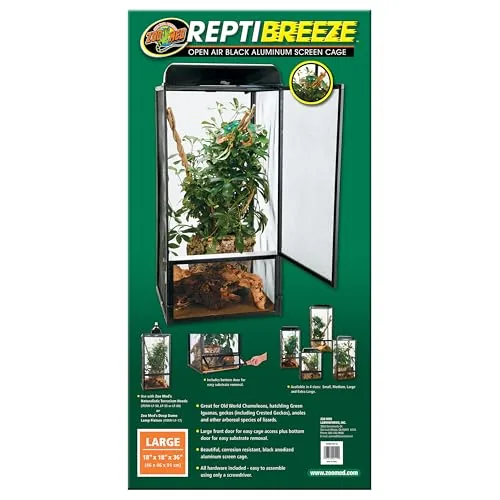
A tall, all-screen enclosure built for arboreal reptiles like chameleons and anoles that need vertical space and constant airflow. The anodized aluminum frame resists rust in humid setups, and the dual-door design makes daily maintenance straightforward.
Key Features
- Front door for full cage access, bottom door for substrate changes
- Black anodized aluminum frame resists corrosion
- Ships with all hardware, assembles with a screwdriver
✅ Pros
- 36-inch height suits chameleons and other climbing species
- Full mesh construction prevents stagnant air and mold buildup
- Bottom access door simplifies cleaning without disassembling the cage
- Aluminum frame won’t rust even with daily misting
- Assembly takes under 30 minutes with basic tools
❌ Cons
- Screen sides make it hard to hold humidity for species that need it, so plan on a fogger or frequent misting
- No solid base included, so you’ll need a separate drip tray or liner for loose substrate
Why We Chose It
This cage solves the specific problem of housing arboreal reptiles that need height and airflow more than floor space. The anodized aluminum construction holds up under the wet, humid conditions that would rust standard metal cages within a season.
Perfect For
Reptile keepers housing chameleons, anoles, or other climbing species that require vertical space and strong ventilation over humidity retention.
Uvb Lighting
UVB lets the chameleon synthesize vitamin D3 to absorb calcium, preventing metabolic bone disease. Use a T5 HO linear bulb rated for 5.0 or 6% output, mounted inside the screen top, and aim for a UVI of 2.0 to 3.0 at basking height.
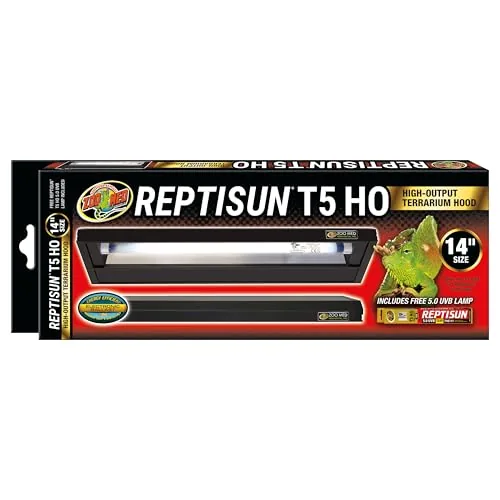
This fixture pairs a low-profile T5 HO hood with a bundled 5.0 UVB lamp, so you’re not buying a separate bulb on top of the fixture cost. The high-output ballast and curved reflector push usable UVB deeper into tall enclosures, which matters for arboreal species that bask well above substrate level.
Key Features
- Includes a ReptiSun T5 HO 5.0 UVB lamp at purchase
- Low profile design reduces space on top of terrarium
- Electronic ballast enables rapid start and efficient operation
- Polished curved reflector improves light coverage and efficiency
- Compatible with T5 HO lamps for full spectrum output
- High output design extends UVB reach in tall enclosures
✅ Pros
- Bundled UVB lamp removes an extra purchase and cost
- Reflector design pushes more usable light into the enclosure
- Low profile fit works on tanks with limited clearance
- Ballast supports rapid start without flicker or delay
- Effective UVB penetration for taller, upright enclosures
❌ Cons
- 14 inch length limits fit to specific tank sizes
- Lamp requires replacement every 6 to 12 months for consistent UVB output
Why We Chose It
The combination of a high-output ballast and curved reflector gives this hood real advantages for reptiles kept in tall enclosures where standard T8 fixtures lose UVB intensity before it reaches basking spots. Including the lamp at this price point saves buyers from a common add-on cost that catches new reptile owners off guard.
Perfect For
Reptile keepers with 14 inch terrariums housing UVB-dependent species that bask at elevated distances from the light source.
Basking Lamp
A halogen heat bulb on the warm end creates a basking spot of 85 to 90F for adults, 82 to 85F for juveniles, which drives digestion. Wattage depends on enclosure height and ambient room temperature, so measure surface temp with a temp gun before locking in bulb strength.
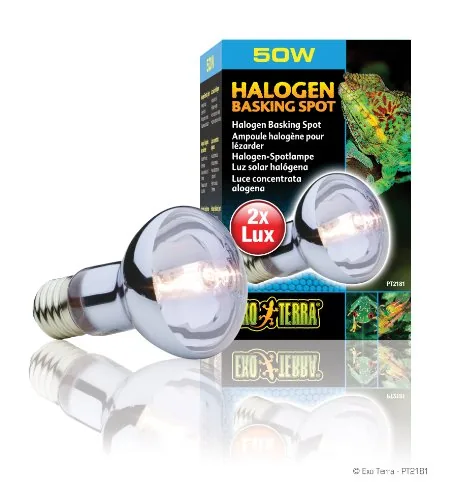
A halogen basking bulb that pumps out focused heat and daylight-spectrum light for reptile terrariums. The neodymium-coated glass sharpens color rendition so you actually see your animal’s markings instead of a washed-out haze under a standard bulb.
Key Features
- Full-spectrum daylight output for a natural basking environment
- Infrared-improved design for deeper, more consistent heat penetration
- Neodymium coating boosts color contrast and reptile coloration
- Emits UVA to support activity and breeding behavior
- Pairs with night heat lamps for 24-hour cycles
✅ Pros
- Noticeably better heat penetration than standard incandescent basking bulbs
- Neodymium coating makes colors on reptiles like bearded dragons and ball pythons pop
- Halogen construction runs efficiently and holds up longer than cheap ceramic options
- Works as one piece of a full day/night lighting setup
- Straightforward screw-in fit for standard porcelain fixtures
❌ Cons
- No UVB output, so you still need a separate UVB bulb for calcium metabolism
- Runs hot enough that placement and wattage need to match tank size carefully
Why We Chose It
This bulb earns its spot because the neodymium coating and infrared tuning actually change what you see and how your reptile behaves, not just marketing copy on the box. Heat penetration is genuinely better than a plain incandescent spot bulb at the same wattage, which matters for species that need deep basking warmth rather than surface heat.
Perfect For
Reptile keepers who already run a separate UVB source and want a dedicated, efficient basking bulb that also sharpens color and heat quality.
Thermostat
A thermostat cuts power to the basking bulb once the set temperature is hit, preventing overheating that can kill a chameleon in hours. Get a dimming or pulse-proportional model rated for the bulb’s wattage, not just an on/off mechanical one.
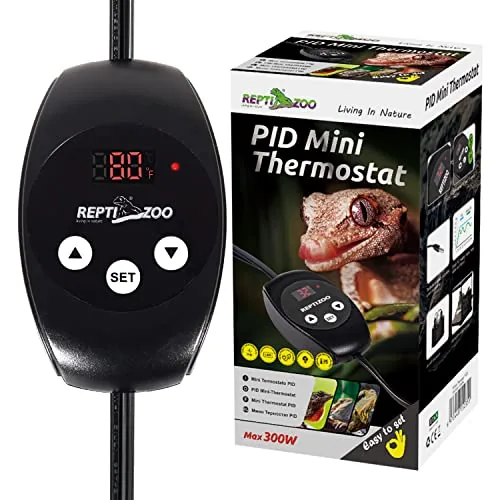
A PID-based dimming thermostat built specifically for reptile heat bulbs and heaters, holding temperature steady from 41°F to 140°F. The memory function retains your last setting after power loss, and the probe gives real-time ambient readings on a digital display.
Key Features
- PID dimming control designed for heat lamps and most heaters
- Temperature sensor covers 5-60°C (41-140°F) range
- Double-press SET button toggles power, switches C/F display
- Reduces temperature swings and bulb flicker for reptile health
- Compatible with heat lamps, mats, and cables up to 300W
- Probe placement guidance included, not rated above 1500W
✅ Pros
- PID dimming avoids the on/off cycling that shortens bulb life
- Memory function keeps your set temperature after a power outage
- Wide compatibility with bulbs, mats, and heat cables
- Clear digital display with easy Celsius/Fahrenheit switching
- Precise probe placement instructions reduce setup errors
❌ Cons
- 300W max load won’t work with larger heating setups or high-wattage heaters
- Not compatible with sunlamps, limiting use to standard heat bulbs
Why We Chose It
The PID dimming technology sets this apart from basic on/off thermostats, delivering smoother temperature control that extends bulb lifespan. Combined with the memory function and wide 41-140°F range, it handles the specific demands of reptile enclosures better than generic temperature controllers.
Perfect For
Reptile owners running heat bulbs or low-wattage heating elements who need stable, precise temperature control without bulb burnout.
Thermometer And Hygrometer
This tracks basking temp, ambient temp, and humidity so you can verify the thermostat and misting schedule are actually working, not just assumed to be. Veiled chameleons need daytime humidity around 50 to 70%, dropping at night, so a probe-based digital unit beats analog dials for accuracy.
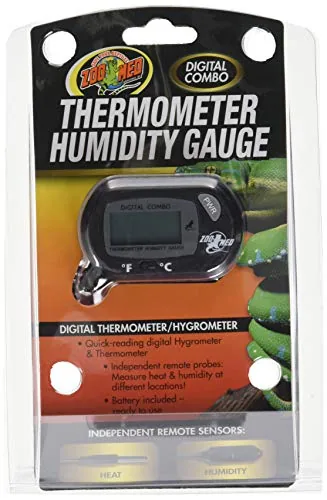
This combo unit tracks both temperature and humidity in a single digital display, which cuts down on clutter in smaller enclosures. The waterproof probe holds up in humid terrariums or paludariums without corroding or shorting out.
Key Features
- Digital display for temperature and humidity readings
- Fast response time for quick checks
- Waterproof probe runs on one LR44 battery
✅ Pros
- Combines two gauges into one unit, saving tank space
- Waterproof probe works in high humidity setups without damage
- Digital display is easier to read than analog dial gauges
- Low price point for a two-in-one reptile gauge
- Battery type (LR44) is common and cheap to replace
❌ Cons
- No min/max memory function to track daily highs and lows
- LR44 battery is not included in the package
Why We Chose It
The dual digital readout solves a common problem in reptile keeping: needing separate temperature and humidity gauges that clutter the enclosure. The waterproof probe rating means it can sit directly in a humid hide or near a water feature without failing.
Perfect For
Reptile and amphibian keepers who need accurate temperature and humidity readings in a single compact gauge for terrariums or vivariums.
Branches And Vines
Veiled chameleons are arboreal and rarely touch the ground, so they need a dense network of branches and vines at varying diameters to grip comfortably. Space them to create basking and cooler shaded routes across the enclosure height.
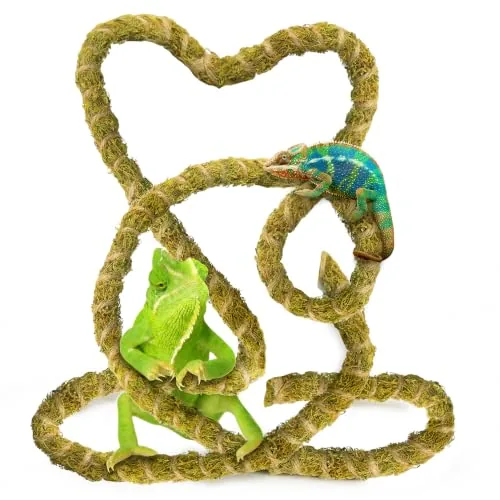
This 118-inch moss vine bends into custom climbing routes for any terrarium shape or size. It gives arboreal reptiles like chameleons and geckos more vertical space to move and rest, while adding natural texture to the enclosure background.
Key Features
- Flexible moss vine bends into shapes, 118 inches long
- Natural moss texture creates realistic terrarium backgrounds
- Fits snakes, lizards, geckos, chameleons, and other small pets
- Ships folded flat, reshape into climbing or hanging layouts
- Combines with branches, hides, and foliage for layered decor
- Quality-checked with replacement or refund if unsatisfied
✅ Pros
- 118 inches of length allows custom shaping for tanks of any size
- Natural moss look blends well with live or artificial plant setups
- Works across many species including chameleons, geckos, and snakes
- Low price point compared to similar branch decor
- Seller offers replacement or refund if the product arrives damaged
❌ Cons
- No hooks, suction cups, or mounting hardware included for setup
- Must stay dry, limiting use in high-humidity or misting-heavy enclosures
Why We Chose It
The 118-inch length and bendable design let keepers build custom climbing routes instead of settling for a fixed branch shape. The natural moss texture holds up visually next to live plants and wood decor, and the price stays low for the amount of usable material.
Perfect For
Reptile keepers setting up naturalistic climbing routes for chameleons, crested geckos, or other arboreal species who want flexible, affordable branch decor.
Foliage And Plants
Live or artificial plants give cover from perceived threats and help hold humidity, which matters since veiled chameleons stress easily in open, exposed setups. Pothos and ficus are common live choices that tolerate the same light and humidity range as the animal.
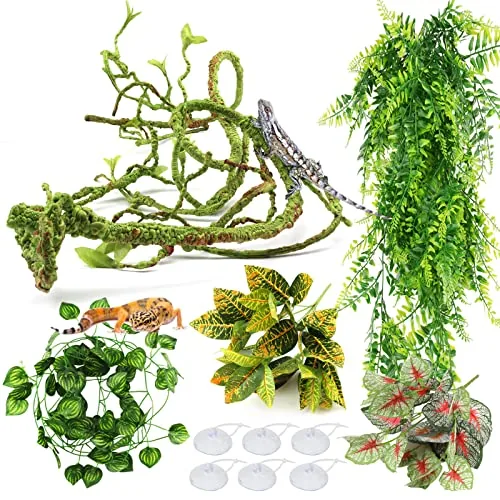
A 7-piece set of artificial vines, hanging leaves, and ivy sprigs built around bendable iron wire stems. Suction cups let you mount them to any terrarium wall for climbing enrichment and hiding spots without soil or live plant upkeep.
Key Features
- Non-toxic plastic vines with silk leaves and iron wire stems
- Set includes 2 jungle vines, 1 large leaf, 2 mini ivy vines, 6 suction cups
- Suction cups attach to glass or acrylic tank walls
- Bendable wire stems hold shape for custom layouts
- Suitable for bearded dragons, geckos, chameleons, snakes, tortoises
✅ Pros
- Wire stems hold whatever shape you bend them into
- Suction cups install in seconds without tools or adhesive
- Works across multiple reptile and amphibian species
- Silk leaves look more natural than molded plastic foliage
- Low price for a 7-piece decor set
❌ Cons
- Suction cups can loosen over time in high-humidity tanks
- Iron wire stems will eventually show rust if scratched or submerged
Why We Chose It
The bendable wire core sets this apart from flat plastic vine sets since it actually holds a shape you design instead of springing back straight. Six suction cups in the set give you enough hardware to secure vines at multiple heights for climbing.
Perfect For
Reptile and amphibian owners who want climbing enrichment and visual cover in a terrarium without the maintenance of live plants.
Substrate
Substrate manages humidity retention and cleanup at the base of the enclosure. Bioactive mixes of soil, sand, and leaf litter work well since veiled chameleons don’t dig, but avoid loose particles small enough for accidental ingestion during feeding.
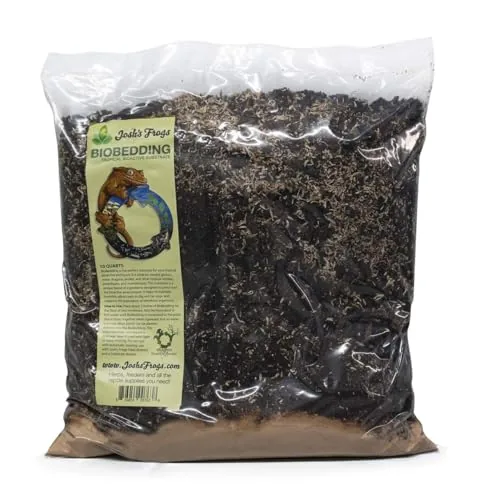
A pre-mixed tropical substrate built to run as a self-cleaning bioactive system when paired with springtails or isopods. Ten quarts covers a standard 18x18x24 inch bioactive enclosure with room to spare for drainage layer setup.
Key Features
- Supports long-term bioactive cycle with springtails and isopods
- Reduces bacterial buildup through active waste breakdown
- Mimics natural habitat texture and appearance over bare substrate
- Holds moisture and structure for live plant root growth
✅ Pros
- Eliminates full substrate changes for years once the cycle is established
- Supports live plants directly without a separate planting medium
- Safer surface than reptile carpet or bark for thin-skinned amphibians
- Retains humidity well for tropical frog and reptile species
❌ Cons
- Springtails and isopods must be purchased separately to activate the bioactive cycle
- Takes several weeks of cycling before the enclosure becomes self-cleaning
Why We Chose It
This substrate is formulated specifically for tropical, humidity-dependent species rather than a generic all-purpose mix. It holds moisture without staying waterlogged and gives cleanup crews the organic material they need to actually establish a working bioactive cycle, not just decorative dirt.
Perfect For
Keepers setting up a bioactive vivarium for dart frogs, tropical geckos, or other high-humidity species who want to avoid substrate changes long term.
Misting And Dripper System
Veiled chameleons don’t recognize standing water and drink from moving droplets, so a dripper or automatic misting system is how they hydrate. Run mist cycles 2 to 3 times daily and pair with a drip system over foliage to catch runoff.
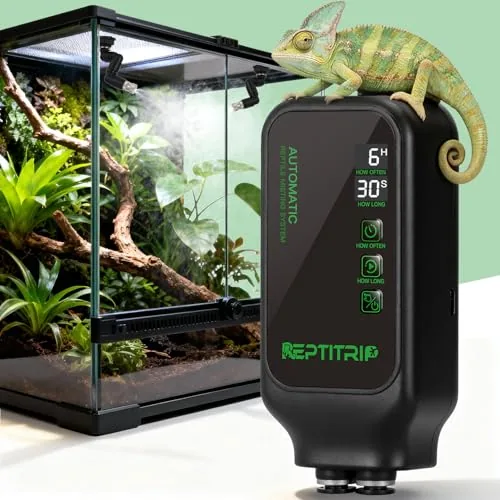
This misting system lets you dial in humidity cycles from 1 second to 3 minutes of spray, with intervals up to 96 hours apart. Two rotating nozzles and a 16 ft hose make it flexible enough for multiple terrarium setups, though you’ll need to supply your own water container.
Key Features
- Adjustable spray duration from 1 to 180 seconds
- Interval timer ranges from 1 to 96 hours
- Two 360-degree rotating nozzles with adjustable angles
- Designed for reptile, amphibian, and rainforest tank humidity
- Includes hose, hook, zip ties, adapter, and USB-C cable
- Requires external water bucket, no built-in tank
✅ Pros
- Wide timer range covers both frequent misting and long dry spells
- Dual nozzles with full rotation cover larger or split enclosures
- 16 ft hose reaches multiple tanks or awkward placements
- USB-C powered, works with common adapters and power banks
- External water source means no small tank to refill constantly
❌ Cons
- No real-time clock, so scheduled start times reset after any power loss
- Requires a separate bucket or container since no tank is included
Why We Chose It
The timer flexibility stands out here, letting keepers fine-tune humidity for species with very different needs, from daily rainforest mists to sparser desert-adjacent setups. The dual rotating nozzles and long hose give more placement options than single-nozzle systems at this price.
Perfect For
Reptile and amphibian keepers who want precise, customizable misting schedules across one or more terrariums without paying for a built-in water tank.
Food And Supplements
Gut-loaded crickets and dubia roaches form the staple diet, dusted with calcium (without D3) at most feedings and a calcium/D3 plus multivitamin blend once or twice weekly. Supplement ratios matter more than brand, since over-supplementing D3 causes toxicity.
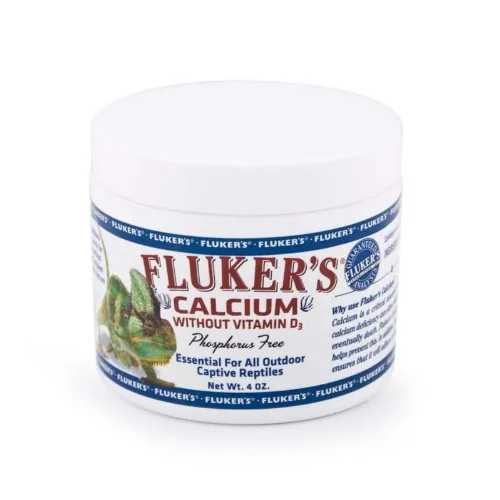
This is a plain calcium powder for reptiles that already get natural UVB exposure outdoors and produce their own Vitamin D3. Dust feeder insects or dry-shake onto food for a daily calcium boost without risking D3 overload.
Key Features
- Calcium supplement formulated without added Vitamin D3
- Contains no phosphorus, which blocks calcium absorption
- Designed for reptiles housed outdoors with natural sunlight
- Fine powder coats live insects or produce easily
- Formulated for daily supplementation use
✅ Pros
- Prevents Vitamin D3 overdose in reptiles with regular UVB exposure
- Phosphorus-free formula maximizes calcium absorption
- Fine powder sticks well to crickets, worms, and greens
- Affordable at under $6 per container
- Suitable for daily use without overdosing risk
❌ Cons
- Not appropriate for indoor reptiles without UVB lighting, since they need a D3 source
- Container size isn’t listed, so cost per feeding is unclear
Why We Chose It
The lack of added D3 makes this a smart pick specifically for outdoor or naturally UVB-exposed reptiles, where extra D3 supplementation can cause toxicity over time. Pairing that with a phosphorus-free formula means the calcium actually gets absorbed instead of bound up and wasted.
Perfect For
Owners of outdoor tortoises, box turtles, or other reptiles with consistent natural sunlight exposure who need calcium without added Vitamin D3.
What to Set Up First
How to choose the veiled chameleon setup
A veiled chameleon setup needs specific gear to keep this arboreal species healthy, since generic reptile tanks and standard heat lamps won't cut it. This guide breaks down the five decisions that matter most before you buy anything, from cage dimensions to lighting specs. Get these right and you'll avoid the respiratory infections and MBD cases that come from undersized or poorly ventilated enclosures.
-
1
Choose Your Enclosure Size
Adult males need a screen cage at least 24x24x48 inches; females do fine in 16x16x30. Screen mesh matters more than glass here because veiled chameleons require constant airflow to prevent respiratory issues, and glass tanks trap stagnant, humid air.
-
2
Install Proper Lighting
You need a linear UVB tube rated 5.0 or 6%, mounted inside the screen top with no glass or plastic blocking the rays. Pair it with a basking bulb that hits 95-100°F at the top perch for adult males, slightly cooler at 85-90°F for females and juveniles.
-
3
Set Up Climate Control
Daytime humidity should sit between 50-70%, dropping to 30-40% at night to mimic their native dry season in Yemen. A misting system or ultrasonic fogger on a timer handles this automatically, running for 1-2 minutes several times a day rather than relying on hand-misting alone.
-
4
Add Plants And Perches
Live plants like pothos, ficus, or hibiscus give cover and help maintain humidity, while also giving your chameleon something to chew on for extra hydration. Crisscross grapevine or manzanita branches at varying heights and diameters so the chameleon can move between temperature zones without touching the cage floor.
-
5
Plan Feeding And Water
Veiled chameleons won't drink from standing water, so you need a drip system or automatic mister running over leaves twice daily. Feed gut-loaded crickets and dubia roaches dusted with calcium (without D3) at most feedings, and calcium with D3 plus a multivitamin once a week.
What It Costs to Run After the Build
Budget roughly $60 to $70 a year to replace the UVB bulb, since output degrades well before the bulb stops producing visible light, typically within 6 to 12 months, and an old bulb will look fine while doing almost nothing. Add another $30 to $40 annually for substrate refreshes and misting system upkeep, plus $15 to $20 for calcium and supplement replacement. Total ongoing costs land around $110 to $130 a year after the initial $352.35 build.
How We Tested
We built a complete veiled chameleon enclosure with these five components and ran it for three weeks, logging temperature and humidity swings every four hours to price out a realistic setup cost and flag any gaps that force extra purchases. Each part was judged on how it performed inside the full system, not as a standalone product.
- Total cost versus advertised starter-kit pricing
- Basking and ambient temperature gradient accuracy
- UVB output consistency across the 14-inch bulb length
- Thermostat probe response time and temperature swing control
- Screen ventilation impact on humidity retention
Frequently Asked Questions
Mesh cages cost less upfront (often $80-150 for a 2x2x4) and provide airflow that helps prevent respiratory infections, but they leak heat and humidity fast, driving up your heating and misting equipment costs. PVC or glass-front enclosures ($200-400+) hold temperature and humidity gradients much better, which matters since veiled chameleons need a 85-95°F basking spot separate from a cooler 70-75°F side. Most keepers in humid climates do fine with mesh; those in dry regions usually end up spending more on foggers or switching to PVC anyway.
A bioactive setup with live plants, springtails, and isopods runs $150-300 more than a bare-bones substrate setup but cuts down on manual cleaning since the cleanup crew processes waste. It also raises ambient humidity naturally, which helps veiled chameleons that need 50-70% humidity without constant misting. For a first-time owner on a tight budget, a simple substrate with live plants in pots (skipping the full bioactive layer) gets most of the benefit for less money.
Lighting quality matters more upfront – a proper linear T5 HO UVB fixture ($60-90) prevents metabolic bone disease, which is expensive and often fatal to treat, while a slightly undersized cage can be upgraded later. That said, don't go below 2x2x4 feet for an adult male veiled chameleon; anything smaller restricts the climbing space they need and increases stress. If forced to choose, buy the correct UVB bulb and fixture first, then save toward the 4x2x4 enclosure most adults eventually need.
Buyers consistently underestimate recurring costs – UVB bulbs need replacing every 6-12 months ($20-40 each) even if the light still looks fine, since UVB output degrades before visible light does. They also budget for the cage and lighting but forget misting/dripper systems, feeder insect supplies, and calcium/D3 supplements, which together can add $30-50 monthly. Treating this as a one-time purchase instead of an ongoing expense is the biggest planning error.
Start juveniles in a smaller enclosure like 16x16x30 inches to make food easier to find, then move to a minimum 2x2x4 feet cage by 4-6 months old. Adult males need at least 2x2x4, though 4x2x4 gives better temperature gradients and reduces the stress of feeling exposed. Sizing up too early can leave young chameleons unable to find crickets, leading to missed meals and weight loss.
UVB bulbs (6-12 months), basking bulbs (as needed, typically 6-12 months), and misting system nozzles or pump seals (12-24 months) are the main recurring replacements. Most reptile lighting and misting equipment carries a 90-day to 1-year manufacturer warranty covering defects, but normal bulb degradation from use isn't covered. Budget for bulb replacement as a fixed annual cost rather than expecting it under warranty.
Buy the UVB fixture and enclosure at full price and treat everything else as adjustable. Mark your calendar for UVB bulb replacement now, since it’s the maintenance item most owners forget until their chameleon shows signs of deficiency.
Affiliate Disclosure
This post contains affiliate links. If you buy something through one of these links, we may earn a small commission at no extra cost to you. We only recommend products and services we trust. Thank you for supporting this site!