A UVB bulb is only as good as the UVI it actually delivers at your animal’s basking spot, not the percentage printed on the box. Output varies by bulb format, decays over months even while the bulb still glows, and gets filtered by screens and reflectors before it ever reaches the reptile. Getting this wrong is a slow problem: the animal looks fine until it doesn’t.
What Actually Separates a Good Reptile UVB Bulb From a Bad One
| What to check | What good looks like | Why it matters |
|---|---|---|
| UVB Output | Match a UVI of 2-3 for forest and crepuscular species or 3-6 for desert baskers, verified at your actual basking distance with a UV index meter rather than the box label. | Too low causes calcium deficiency and metabolic bone disease; too high causes photokeratitis and skin damage. |
| Bulb Format | Use linear T5 HO tubes for enclosures taller than 18 inches and reserve compact coils for setups under 12 inches of basking height. | Compact coils can’t project usable UVB past about 10-12 inches, leaving taller basking spots effectively dark on UV. |
| Basking Distance | Check the bulb’s printed dosing chart for exact inches; most 6% T5 HO bulbs are rated 8-12 inches and 10.0 bulbs 6-10 inches. | Moving the perch even 4 inches closer or farther can push UVI outside the safe range in either direction. |
| Lifespan | Replace linear bulbs every 10-12 months and compact coils every 6 months regardless of whether they still produce visible light. | UVB output typically drops 30-50% before the bulb burns out, so a reptile can bask under a bulb doing nothing. |
| Screen Compatibility | Confirm whether the mesh or screen top between bulb and animal is UV-rated, since standard aluminum screen can block 30-50% of usable UVB. | A correctly chosen bulb paired with the wrong screen still leaves the reptile under-dosed. |
Matching UVB Output To Species Needs
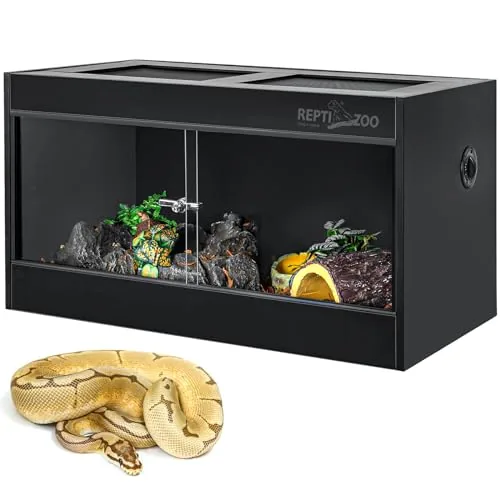
Reptile UVB needs break down by natural basking behavior, not by species name alone. Desert baskers like bearded dragons and uromastyx evolved under open sun and need a UVI of 3-6 at the basking spot. Forest-floor and crepuscular species like leopard geckos or ball pythons get by on indirect light and need closer to 1-2 UVI. Arboreal species like crested geckos and many chameleons sit in the middle, around 2-4 UVI, but need that output spread over more vertical distance since they climb rather than sit under a fixed basking spot. The mistake is buying a bulb rated by percentage and assuming it matches a species without checking the actual UVI at your setup’s measured basking distance. Enclosure height matters here too, since a tank too short forces the bulb closer than its rated range allows, pushing UVI too high. If you’re building the enclosure around the bulb rather than the other way around, start with the tank height and ventilation needs for your species, then pick the bulb and distance to match.
What The Percentage Label Doesn’t Tell You
The number printed on a UVB bulb, whether it’s 5.0, 10.0, 6%, or 12%, isn’t a standardized unit across manufacturers. One brand’s 10.0 can produce a different UVI at 12 inches than another brand’s 10.0, because the percentage refers to the proportion of UVB in the bulb’s total UV output, not the irradiance actually reaching your reptile. Two bulbs with identical labels can differ by a full UVI point or more at the same distance, depending on bulb age, reflector design, and manufacturing quality control. The only way to know what your reptile is getting is to measure it with a UV index meter at the exact basking distance you’re using. This also means a bulb that tested fine at installation can drift out of range within months as output decays, even though the label doesn’t change. Treat the percentage as a rough starting category, not a precise spec, and re-measure every few months if you’re running a species sensitive to over or under-exposure, like chameleons.
Bulb Format And Fixture Fit
Linear fluorescent T5 HO tubes, compact fluorescent coils, and mercury vapor bulbs all produce UVB, but they spread it differently. T5 HO tubes throw usable UVB across their entire length, which matters for naturalistic enclosures where the basking zone is wider than a single spot bulb can cover. Compact coils concentrate output into a small cone, making them cheaper for small tanks but useless for enclosures where the reptile roams more than a foot from the fixture. Mercury vapor bulbs combine heat and UVB in one bulb, which simplifies wiring but removes independent control over basking temperature versus UV dose, so an incorrect bulb choice causes two problems at once. None of this works without a fixture that holds the bulb’s output instead of absorbing it. A cheap reflector can cut delivered UVB by half even with a correctly chosen bulb, which is why pairing it with a fixture with a reliable reflector matters as much as the bulb spec itself. Buying the right bulb for the wrong fixture wastes most of what you paid for.
Screen Mesh, Distance Checks, And Replacement Timing
A correctly specified bulb still underperforms if something sits between it and the reptile. Standard aluminum screen tops block 30 to 50 percent of usable UVB, so a bulb calibrated to deliver 4 UVI through open air might deliver closer to 2 UVI through mesh, enough to tip a desert species back into deficiency range. If your setup uses a screen lid, check whether it’s rated for UV transparency, or account for the loss by shortening the basking distance; a mesh designed for UV passthrough avoids the guesswork. Distance matters just as much: measure from the bulb itself, not the top of the enclosure, since fixture housings and reflectors add several inches you’d otherwise miss. Mark your calendar when you install a new bulb. Linear bulbs lose meaningful output around the 10 to 12 month mark, compact coils closer to 6 months, regardless of whether the bulb still glows normally. A bulb that still lights up but has decayed past its usable UVB range looks fine and does nothing, which is worse than no bulb at all because it creates false confidence.
Mistakes to Avoid
- Buying a 10.0 bulb for a leopard gecko tank because higher output seemed safer, pushing UVI far above what the species tolerates.
- Mounting a linear UVB tube behind a standard aluminum screen top without accounting for the 30-50% UV loss the mesh causes.
- Leaving a compact coil bulb running for a year or more because it still produces visible light, not realizing UVB output decayed months earlier.
- Setting basking distance based on the outside of the fixture housing instead of measuring the actual inches from the bulb itself.
Frequently Asked Questions
T5 HO linear fluorescent tubes output UVB more evenly across their length and maintain usable UV index out to 12-16 inches, depending on wattage and reflector design. Compact coil bulbs produce a narrower, more concentrated beam that drops off sharply past 8-10 inches and has been linked to eye and skin irritation in some reptiles from uneven dosing. For any enclosure over 18 inches tall, T5 HO is the more reliable option.
Yes, for most setups. A T5 HO bulb runs $25-40 plus a $30-50 fixture, versus $15-20 for a coil bulb and screw-in dome, but the T5 HO lasts 10-12 months of effective UVB output compared to 6 months for coil bulbs before UV degrades below usable levels. Over a year, the cost difference is small, and the T5 HO delivers more consistent UVI across the basking zone.
Match the bulb's output to your species' Ferguson zone: Zone 1 animals like leopard geckos need UVI 0.7-1.0 at basking distance, Zone 2 species like bearded dragons in shade need 1.0-2.6, and Zone 3 baskers like green iguanas need 2.6-7.4. A 5% UVB bulb suits lower zones while a 10-12% bulb is needed for high-UVI baskers, but actual output depends heavily on distance and whether mesh covers the fixture.
Buyers often assume a bulb that still produces visible light is still producing usable UVB, but UVB output degrades much faster than visible brightness and can drop to near zero while the bulb still glows normally. Another frequent error is ignoring mesh screen toppers, which can block 30-50% of UVB output depending on mesh density, so the bulb needs to be rated or positioned to compensate.
The bulb and fixture should span at least two-thirds of the enclosure's length to let your reptile thermoregulate by moving in and out of the UV gradient. For a 36-inch enclosure, a 24-inch T5 HO fixture mounted toward the basking end works better than a short coil bulb centered overhead. Always check the fixture's wattage matches the bulb type, since T5 HO and T8 bulbs aren't interchangeable in the same housing.
Linear T5 HO bulbs need replacement every 10-12 months and compact coil or T8 bulbs every 6 months, regardless of whether the bulb still lights up, since UVB output decays well before visible light fails. Most manufacturers only warranty against manufacturing defects for 90 days to a year and do not cover UV output decay, so track replacement dates separately rather than relying on warranty claims.
A good UVB bulb comes down to matching UVI output to your species’ natural basking zone, confirming that output with a meter instead of trusting the label, and replacing the bulb on a schedule instead of waiting for it to burn out. The fixture, screen, and basking distance all change what actually reaches your reptile. Get the system right and calcium metabolism takes care of itself.
Affiliate Disclosure
This post contains affiliate links. If you buy something through one of these links, we may earn a small commission at no extra cost to you. We only recommend products and services we trust. Thank you for supporting this site!