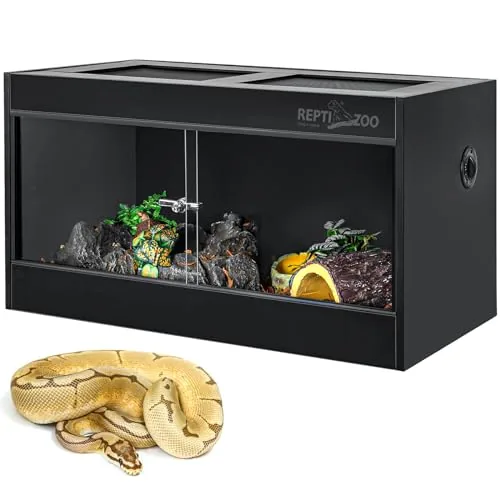
A reptile terrarium fails for one of two reasons: it doesn’t match the species’ actual space and climate needs, or it doesn’t hold a secure seal once you add heat and humidity. The tank that looks good on a shelf can still let heat escape through a loose screen top or trap stagnant air that breeds mold. Getting this right means matching five specific features to the animal you’re keeping, not picking whatever size is cheapest.
What Actually Separates a Good Reptile Terrarium From a Bad One
| What to check | What good looks like | Why it matters |
|---|---|---|
| Tank Size | Match floor space and height to the adult size of the species, not the juvenile you’re bringing home (a 40-gallon breeder is a common minimum for mid-size lizards). | An undersized tank prevents a proper thermal gradient, so the animal can’t move between hot and cool zones to regulate its body temperature. |
| Ventilation | Look for cross-ventilation through mesh panels on at least two sides, not a single screen top. | One-sided ventilation traps stagnant, uneven air that lets humidity spike in corners and invites mold and respiratory infections. |
| Door Access | Front-opening doors with a sliding or two-point lock work better than top-lift lids for defensive or fast-moving species. | Reaching in from above startles animals that read overhead movement as a predator attack, increasing bites and stress. |
| Material | Glass holds up to scratching and cleans easily; PVC insulates better and retains humidity; wood/melamine is lightest but swells if it gets wet. | The wrong material means constant heat loss, warped panels, or a tank that’s too heavy to move for cleaning. |
| Lid Security | Metal locking clips rated for the species’ strength, not a screen that just rests on top. | A lid that shifts under pressure leads to escapes or a dislodged heat lamp that can burn the enclosure or the animal. |
Material Trade-offs: Glass, PVC, and Wire
Glass terrariums are the default for a reason: they’re scratch-resistant, easy to wipe down, and let you see the animal from any angle. The trade-off is weight and heat loss, since glass conducts temperature changes from the room faster than other materials. PVC panels insulate better and hold humidity longer, which is why you see the same construction show up in humidity-retaining PVC enclosures built for moisture-sensitive invertebrates. Wire or mesh cages solve the opposite problem: species that need heavy airflow and can’t tolerate trapped humidity do better in an enclosure that’s mostly screen, even though that rules out keeping any tropical species that needs a stable, moist microclimate. Wood and melamine fall in the middle, lightweight and good at holding heat, but they swell and delaminate if water gets into seams, which happens often in a tank you mist daily. None of these materials is universally correct. The decision comes down to whether your species needs to retain moisture, shed heat, or move air, and picking a terrarium built for the wrong priority undoes everything else you get right with lighting and substrate.
Matching Floor Space and Height to the Species
Terrarium dimensions aren’t interchangeable just because the gallon rating matches. A ground-dwelling species that spends its life moving across a floor needs width and depth far more than height, which is why floor-space-first tanks built for burrowing snakes look short and wide compared to tanks for climbing species. An arboreal gecko or chameleon needs the opposite ratio: a tall, narrow footprint that gives it vertical territory to establish basking and cooling zones at different heights. Buying a tall tank for a floor-dwelling species wastes space the animal never uses and makes it harder to maintain a flat temperature gradient near the substrate. Buying a wide, short tank for a climbing species does the reverse, forcing it to stay near the heat source with no way to retreat to a cooler upper zone. Check the natural behavior of the species before you check the gallon number. A 40-gallon tank shaped wrong for the animal inside it causes more stress than a smaller tank with the right proportions.
What Ventilation Specs Don’t Tell You
Manufacturers list ventilation as a feature without saying how much airflow it actually provides. A screen top covering the entire lid sounds like plenty of ventilation, but if it’s the only vented surface, air near the substrate barely moves, and humidity collects unevenly along the bottom third of the tank. Species that need high humidity but also need airflow to prevent mold, like many arboreal frogs and geckos, do best with side vents positioned low and high so air can actually cycle instead of just escaping from the top. Mesh size matters too: fine mesh restricts airflow more than it looks like it should, while wide mesh lets small feeder insects escape before your animal eats them. Clip strength on any screen top matters as much as the mesh itself, since a top that lifts under light pressure is a security risk, not just a ventilation one. None of this shows up in a product listing that just says ‘ventilated lid.’ You have to check vent placement and count the number of vented sides before assuming the airflow matches what the species needs.
When Paying More Actually Helps
The jump in price between a basic terrarium and a premium one usually buys three things: hinge quality, seal tightness, and raised vent placement that keeps humidity from pooling at one level. Cheap hinges crack within a year of daily opening and closing, especially on front-opening doors that get used twice a day for feeding and misting. A tighter seal around the door frame matters more for humidity-dependent species than it does for a dry-climate lizard, since every gap is a spot where moisture escapes faster than your fogger or mister can replace it. None of this replaces the need for accurate temperature control, which depends on separate equipment entirely. A well-built terrarium with a poorly calibrated thermostat still runs hot or cold, so budget for both rather than assuming a better tank fixes heating problems on its own. Spend more on construction details that affect daily use and long-term seal integrity, not on cosmetic features like tinted glass or decorative trim that don’t change how the enclosure functions for the animal inside it.
Mistakes to Avoid
- Buying a 10-gallon starter tank for a species like a bearded dragon or ball python that outgrows it within a year.
- Choosing a tall vertical tank for a ground-dwelling species like a leopard gecko instead of prioritizing floor space.
- Assuming a screen top alone provides enough ventilation for a humidity-loving species, which leads to dry air and failed sheds.
- Skipping locking clips on the lid for a strong or escape-prone species, discovering the gap only after the animal is gone.
Frequently Asked Questions
PVC enclosures hold heat and humidity more efficiently because the panels insulate better than glass, which makes them a stronger choice for tropical species like crested geckos or ball pythons. Glass terrariums lose heat faster but offer better visibility and are easier to find in standard sizes. If you're keeping a desert species that needs a basking gradient rather than warmth, glass works fine and costs less.
Front-opening doors cost $20-50 more but prevent heat and humidity from escaping every time you access the enclosure, which matters for arboreal species or anything requiring stable humidity above 60%. They also reduce stress for skittish reptiles since you're not reaching down from above like a predator would. For hardy, ground-dwelling species like leopard geckos, a top-opening tank saves money without hurting husbandry outcomes.
Full screen tops maximize airflow, which suits arid species but makes it hard to maintain humidity above 50% without constant misting. Solid or mostly-solid tops with small vents retain humidity better for tropical setups but require active temperature monitoring to prevent overheating under strong bulbs. Match the ventilation ratio to your species' native humidity range before picking tank size, since the wrong top can undermine even a correctly sized enclosure.
Buyers often size the enclosure for the juvenile's current length instead of its adult size, then have to rebuy a larger tank within a year. This also leads to overfeeding and handling stress because small tanks make reptiles feel exposed rather than secure. Buying for adult size upfront and using plants or hides to create a sense of enclosure for juveniles avoids both problems.
Most 20-40 gallon terrariums are built to standard lengths (24, 36, or 48 inches) that match off-the-shelf UVB fixtures and dome heat lamps without modification. Custom or imported enclosures sometimes use metric dimensions that leave gaps or overhang with US-standard fixtures, so check the canopy width before ordering. Always confirm clearance height too, since tall fixtures can reduce usable vertical space for climbing species.
A well-maintained glass terrarium lasts 10-15 years, with silicone seams being the most common failure point due to humidity breakdown and substrate acids. PVC enclosures last longer, often 15-20 years, because they don't rely on silicone for structural seams. Warranties in this category are usually limited to 1-2 years and rarely cover seal failure from normal humidity exposure, so factor replacement seams into long-term cost.
A good terrarium matches its size, shape, ventilation, material, and lid security to the specific species you’re keeping, not to whatever tank happens to be on sale. Check how the animal moves and breathes in the wild before you check the price tag. The right terrarium makes every other part of the setup, heating, humidity, and lighting, easier to get right and keep stable.
Affiliate Disclosure
This post contains affiliate links. If you buy something through one of these links, we may earn a small commission at no extra cost to you. We only recommend products and services we trust. Thank you for supporting this site!