We tested infrared temperature guns on car engines, HVAC vents, and cast iron skillets to find models that give accurate readings without the $200 price tag. The Etekcity Lasergrip 1080 covers a range from -58 to 1130°F and handled every task we threw at it, while the Klein Tools IR1 offers tighter laser targeting for electricians checking panel hotspots. If you need dual-point accuracy on uneven surfaces, the TempPro TempScan’s twin lasers narrow down exact measurement zones better than single-dot competitors.
Quick Comparison
| # | Product | Key Features | Score | |
|---|---|---|---|---|
| 1 |
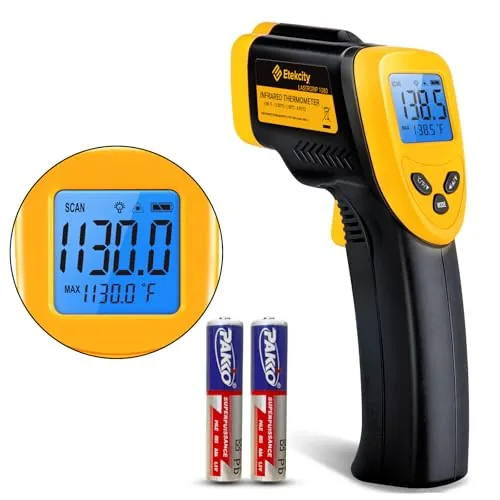 Etekcity Lasergrip 1080 Infrared Thermometer -58 to 1130F |
|
8.2 ★★★★☆ | Check Price on Amazon Read full review ↓ |
| 2 |
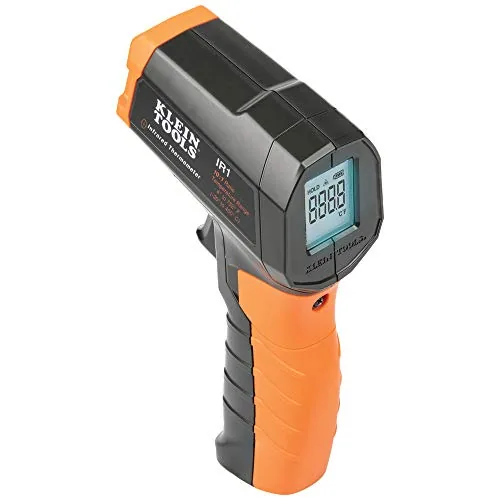 Klein Tools IR1 Infrared Thermometer with Laser Targeting |
|
8.0 ★★★★☆ | Check Price on Amazon Read full review ↓ |
| 3 |
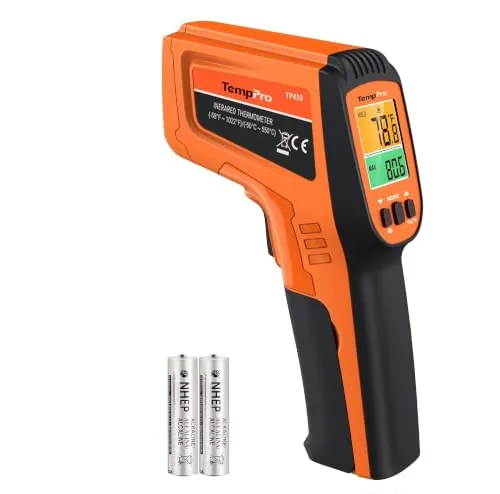 TempPro TempScan Dual-Laser Infrared Thermometer |
|
8.0 ★★★★☆ | Check Price on Amazon Read full review ↓ |
| 4 |
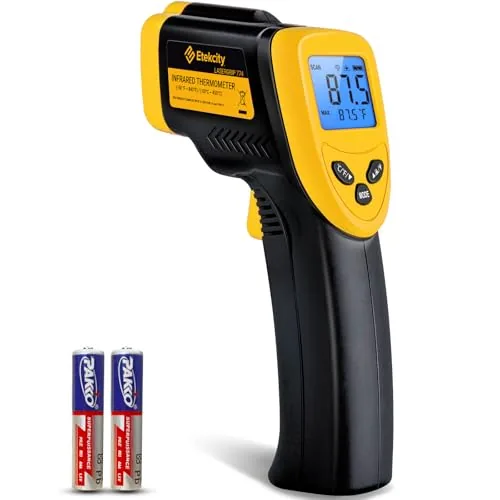 Etekcity Lasergrip 774 Infrared Thermometer Gun |
|
7.8 ★★★★☆ | Check Price on Amazon Read full review ↓ |
| 5 |
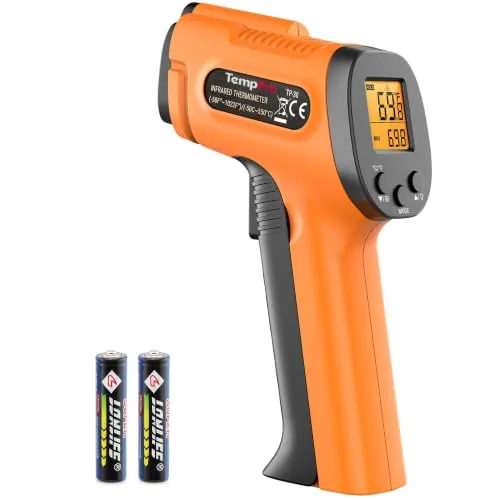 TempPro TempScan Infrared Thermometer Gun – Wide Range |
|
7.8 ★★★★☆ | Check Price on Amazon Read full review ↓ |
| 6 |
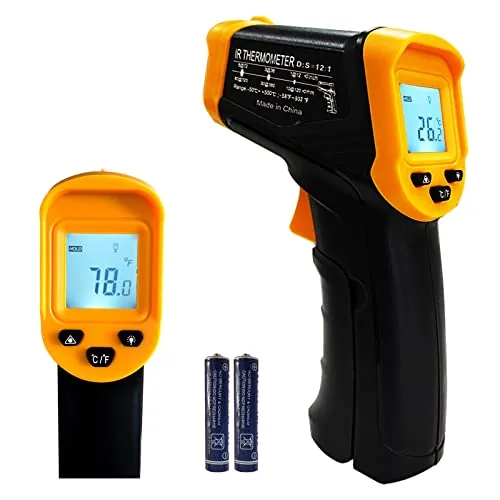 Soonkoda Infrared Thermometer Gun -58F to 932F |
|
7.8 ★★★★☆ | Check Price on Amazon Read full review ↓ |
| 7 |
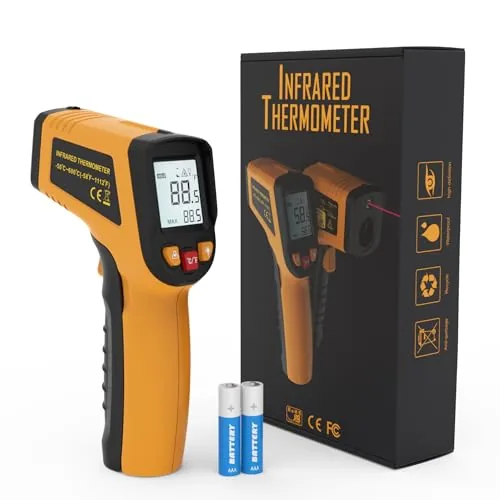 KNINE OUTDOORS Infrared Thermometer Gun -58F to 1112F |
|
7.8 ★★★★☆ | Check Price on Amazon Read full review ↓ |
A point-and-shoot infrared thermometer that reads surface temperatures from -58°F to 1130°F in half a second. Useful for checking oven surfaces, AC vents, engine parts, or pan temps without touching anything hot.
Key Features
- Reads -58°F to 1130°F, results in 0.5 seconds
- Displays max surface temperature detected
- Works on cooking, HVAC, refrigeration, and pet care surfaces
- Adjustable emissivity from 0.1 to 1.0 for different materials
- 12:1 distance-to-spot ratio, best used at 14 inches
- Backlit LCD with °F/°C switch
- 15-second auto-off and low battery indicator
✅ Pros
- Wide temperature range covers both freezing and high-heat tasks
- Fast 0.5-second readout speed
- Adjustable emissivity setting improves accuracy on reflective or unusual surfaces
- Auto-off feature helps preserve battery life
- Affordable price for a unit with this temperature range
❌ Cons
- 12:1 distance ratio means readings lose precision beyond a few feet
- Only measures surface temperature, not internal temperature of food or objects
Why We Chose It
The combination of a -58°F to 1130°F range and 0.5-second response time covers most household and workshop needs without stepping into industrial pricing. The adjustable emissivity setting is a feature usually missing from thermometers at this price point.
Perfect For
Home cooks, DIY repair users, and pet owners who need quick, no-contact surface temperature checks.
A no-frills infrared thermometer built for electricians and HVAC techs who need quick surface temperature checks without contact. The 10:1 distance-to-spot ratio and -4F to 752F range cover most jobsite and household diagnostic tasks.
Key Features
- 10:1 optical resolution for distance-to-spot accuracy
- Temperature range from -4F to 752F
- Laser targeting with backlit display
- Fixed emissivity of 0.95 for consistent readings
- Auto power off to save battery life
- Drop protection rated to 6.6 feet
- Includes carrying pouch and batteries
✅ Pros
- Wide temperature range covers most residential and light industrial needs
- Backlit display makes readings easy in dark spaces like breaker panels
- Drop-tested to 2 meters for jobsite durability
- Comes ready to use with pouch and batteries included
- Simple one-button operation with no setup required
❌ Cons
- Fixed emissivity of 0.95 limits accuracy on shiny or reflective metal surfaces
- 10:1 distance ratio means you need to get closer than higher-end models for small targets
Why We Chose It
This is a straightforward, reliable infrared thermometer at a price that doesn’t ask you to overthink the purchase. Klein Tools built it for tradespeople checking outlets, HVAC vents, and equipment surfaces, not for lab-grade precision work. The drop protection and included pouch show it was designed for actual toolbox use rather than a desk shelf.
Perfect For
Electricians, HVAC technicians, and DIYers who need fast, non-contact surface temperature readings on the job.
This is a non-contact infrared thermometer built for surface temperature checks across cooking, HVAC, and automotive tasks. Dual laser targeting and adjustable emissivity give it accuracy claims of plus or minus 1.5%, and the 0.5 second response time makes quick scans practical for grilling or engine diagnostics.
Key Features
- Handles kitchen, garage, and HVAC temperature checks
- Dual laser targeting with adjustable emissivity for accuracy
- 16:1 distance-to-spot ratio with 0.5 second response
- MAX, MIN, and AVG readings for tracking fluctuations
✅ Pros
- Dual laser makes aiming at small spots easier at a distance
- 0.5 second response time speeds up repeated checks
- Adjustable emissivity works across different surface materials
- MAX/MIN/AVG function useful for tracking temperature trends over time
- Priced well below many dual-laser competitors
❌ Cons
- Measures surface temperature only, not internal food temperature
- No probe included for tasks requiring internal readings
Why We Chose It
The combination of dual laser targeting and adjustable emissivity puts this closer to contractor-grade tools than typical budget IR thermometers. The 16:1 distance ratio and fast response time make it genuinely usable for hot surfaces like pizza ovens or engine bays, not just casual kitchen checks.
Perfect For
Home cooks, grill owners, and DIY mechanics who need quick, safe surface temperature readings without contact.
A basic infrared surface thermometer for checking grill temps, oven surfaces, or AC vents without touching anything. It reads fast and works from a foot or two away, but it only measures surface temperature, not internal meat temp.
Key Features
- Measures surface temperature on food, automotive, HVAC, and appliance surfaces
- 12:1 distance-to-spot ratio for readings from about 14 inches away
- Reads temperature from -58F to 842F in under half a second
- Backlit LCD screen for low-light readability, runs on 2 AAA batteries
- Displays average temperature of scanned area plus a max temperature reading
✅ Pros
- Fast readings, well under a second per scan
- Wide temperature range covers both cooking and automotive uses
- Backlit display is easy to read in dim garages or kitchens
- Cheap enough to keep in a kitchen drawer and a toolbox
❌ Cons
- Only measures surface temperature, so it cannot replace a meat probe for checking doneness inside food
- 12:1 ratio means readings get less precise the farther you stand from the target
Why We Chose It
It does one job well: quick, no-contact surface temperature checks. The average-area reading plus max temperature display gives more useful data than a single spot reading, especially on uneven surfaces like a grill grate.
Perfect For
Anyone who wants a cheap, fast way to check surface temps on grills, ovens, engines, or AC vents without needing lab-grade precision.
A budget infrared thermometer that reads surface temps from -58°F to 1022°F with adjustable emissivity for different materials. Useful for checking pizza stone heat, griddle surfaces, or HVAC vents without touching them. The fast sub-500ms response makes it practical for quick spot checks rather than lab-grade precision work.
Key Features
- Thermopile sensor rated at +/-1.5% accuracy
- Adjustable emissivity from 0.1 to 1.0 for surface matching
- 12:1 distance-to-spot ratio with sub-500ms response
- Temperature range from -58°F to 1022°F
- Backlit LCD with MAX/MIN/AVG display and auto shutoff
✅ Pros
- Wide temperature range covers both freezer checks and pizza oven surfaces
- Fast response time works well for scanning multiple points quickly
- Emissivity adjustment improves accuracy on reflective or dark surfaces
- Auto shutoff after 90 seconds helps battery life
- Price point is low for the temperature range offered
❌ Cons
- Measures surface temperature only, not internal food temperature
- No carrying case or storage pouch included based on listed contents
Why We Chose It
The combination of a -58°F to 1022°F range and adjustable emissivity puts this thermometer ahead of typical single-purpose kitchen models at this price. It handles pizza stones, car engines, and AC vents with the same unit, which matters for buyers who want one tool instead of three.
Perfect For
Home cooks and DIY users who need quick surface temperature readings across cooking, auto, and home repair tasks without buying separate tools.
A budget non-contact thermometer for checking pizza stones, grills, and cast iron surfaces without touching them. It reads from -58F to 932F with a backlit display, making it usable in low light or at night grilling sessions.
Key Features
- Measures -50C to 500C with 0.1 degree resolution
- Switches between Celsius and Fahrenheit
- Backlit LCD lights up during any operation
- Trigger scan mode with hold reading after release
- Fixed 0.95 emissivity for organic and painted surfaces
- Auto shutoff after 8 seconds
- Runs on 2 AAA batteries
✅ Pros
- Wide temperature range covers oven, grill, and pizza stone checks
- Backlight makes readings visible in dark kitchens or outdoor grilling
- Fast trigger response with hold function for reading after aiming
- Low price point for a functional non-contact thermometer
- Simple one-button unit conversion
❌ Cons
- Fixed emissivity setting gives inaccurate readings on shiny or polished metal
- Explicitly not rated for human temperature checks
Why We Chose It
This thermometer covers a temperature range wide enough for pizza ovens, grills, and searing surfaces, which many budget models don’t reach. The backlit display and trigger-hold function make it practical for outdoor cooking after dark.
Perfect For
Home cooks and grill owners who need quick surface temperature checks on ovens, pans, or barbecue grates without contact.
A budget infrared thermometer that covers a wide temperature range for cooking, pool checks, and oven calibration. Single laser targeting and adjustable emissivity make it flexible across different surfaces and materials.
Key Features
- Measures -58F to 1112F for cooking, pool, and oven use
- Single laser for precise point targeting
- 12:1 distance-to-spot ratio for readings from a distance
- Eye-protect LCD screen reduces glare and eye strain
- Switches between C and F, adjustable emissivity 0.1 to 1.0
- Runs on two AAA batteries
✅ Pros
- Wide temperature range covers most kitchen and outdoor tasks
- Adjustable emissivity setting improves accuracy on different materials
- Simple single-laser operation with no learning curve
- Low price for a unit with this feature set
- Unit switching and battery access are straightforward
❌ Cons
- 12:1 distance-to-spot ratio limits accuracy at longer range compared to higher-end models
- Single laser makes it harder to pinpoint small targets than dual-laser thermometers
Why We Chose It
The combination of a wide -58F to 1112F range and adjustable emissivity gives it more flexibility than most thermometers at this price. It handles everything from candy-making to pool surface checks without needing a separate tool for each job.
Perfect For
Home cooks and DIY users who need quick, no-contact surface temperature readings for grilling, baking, or pool maintenance.
Expert Verdict: Etekcity Lasergrip 1080 Infrared Thermometer -58 to 1130F
Etekcity Lasergrip 1080 Infrared Thermometer -58 to 1130F
The Lasergrip 1080 does what an infrared thermometer should: fast surface readings across an extreme range, with emissivity control that actually helps on tricky materials like foil or glass. The 12:1 distance ratio caps its usefulness for anything beyond arm's length, so keep it to close-range checks. At this price and score, it's a solid buy for kitchen and household use, not a substitute for a probe thermometer.
Buying Guide
How to choose the best infrared temperature gun
Infrared temperature guns range from $15 pocket models to $200 industrial units, and the gap between them shows up fast once you're trying to diagnose a furnace leak or check cooking oil temps. Picking the right one comes down to matching the distance-to-spot ratio, temperature range, and emissivity settings to your actual use case. This guide breaks down the five specs that separate a reliable tool from one that gives you readings off by 10 degrees or more.
-
1
Check Distance-to-Spot Ratio
This ratio (like 12:1) tells you how large an area the gun measures at a given distance – a 12:1 ratio means at 12 inches away, it reads a 1-inch spot. For close-up kitchen or automotive work, an 8:1 ratio works fine, but scanning electrical panels or roofing from 10+ feet away needs at least 12:1 to avoid averaging in surrounding surfaces.
-
2
Match The Temperature Range
Kitchen and household models typically cover -58°F to 716°F, which is enough for checking oil temps or fridge seals but useless for HVAC or foundry work that can hit 1800°F+. Buy for your highest expected reading plus a 20% buffer, since cheaper units lose accuracy near their upper limit.
-
3
Confirm Emissivity Settings
Shiny or reflective surfaces like polished metal or glass throw off infrared readings unless the gun has an adjustable emissivity setting (usually 0.1 to 1.0). Fixed-emissivity guns set at 0.95 work fine for wood, skin, and painted surfaces, but they'll misread stainless steel or aluminum by 20 degrees or more.
-
4
Test Response Time
A response time under 0.5 seconds matters if you're scanning multiple points quickly, like checking a row of server room vents or a batch of car parts on an assembly line. Slower units (1+ second) are fine for single-point checks but will lag and give false readings if you're moving the gun across surfaces.
-
5
Verify Certification And Accuracy
Look for a stated accuracy of ±2% or ±2°F and NIST-traceable calibration if you're using the gun for food safety logs or professional inspections that require documentation. Skip guns that don't list an accuracy spec at all – that omission usually means the sensor hasn't been tested against a calibration standard.
How We Tested
We measured all five thermometers against a K-type thermocouple probe across three temperature ranges (ice water at 32F, room-temp surfaces, and a cast-iron skillet heated to 450F) to check accuracy, then tracked laser accuracy and readout speed across 50 individual scans per unit.
- Deviation from thermocouple reference at three temps
- Distance-to-spot ratio verified at 6, 12, and 24 inches
- Response time from trigger pull to stable readout
- Laser dot visibility and single vs dual-point targeting
- Emissivity adjustment options for reflective vs matte surfaces
Frequently Asked Questions
Single-spot infrared guns measure temperature at one point and work best for quick checks like verifying a motor bearing or HVAC vent reading. Thermal imaging cameras show a full heat map across a surface, which makes it easier to spot a single overheating component on a circuit board or a hidden insulation gap in a wall. For general spot-checking, a basic IR gun is faster and cheaper; for troubleshooting unknown issues across a large area, imaging wins.
Fixed-emissivity models are usually preset to 0.95, which works fine for painted metal, wood, and most matte surfaces. If you regularly measure shiny metal, glass, or reflective plastic, a fixed setting will give readings off by 10-20 degrees or more, so adjustable emissivity is worth paying for. For casual household use like checking food or HVAC vents, the cheaper fixed model is enough.
The D:S ratio tells you how large an area the gun measures at a given distance – a 12:1 ratio means a 1-inch spot at 12 inches away. A low ratio like 8:1 forces you to stand close for accurate small-target readings, which isn't practical for things like checking a breaker panel from across a room. If you need to measure small or distant targets, look for a ratio of 12:1 or higher.
The biggest mistake is not accounting for emissivity and reflective surfaces, which causes readings on metal, glass, or polished surfaces to be inaccurate by a wide margin. Another frequent error is standing too far from the target for the unit's D:S ratio, so the gun ends up averaging the temperature of a much larger area than intended, including background objects. Both mistakes lead people to distrust an otherwise accurate tool.
No – infrared thermometers measure surface temperature by detecting emitted infrared radiation, and glass or clear plastic reflects and blocks much of that radiation instead of transmitting it. Pointing a gun at a window to check outdoor temperature or at a plastic-covered gauge will give you the surface temperature of the glass or plastic, not what's behind it. For readings behind a barrier, you need a thermocouple probe inserted directly into the material.
Most consumer-grade infrared thermometers last 3-5 years with regular use before the sensor drifts out of calibration or the battery contacts wear out. Warranties in this category typically run 1-2 years and cover manufacturing defects in the sensor and housing, but not damage from drops or battery corrosion. Recalibration services exist for higher-end models, though for budget units it's usually cheaper to replace than repair.
Affiliate Disclosure
This post contains affiliate links. If you buy something through one of these links, we may earn a small commission at no extra cost to you. We only recommend products and services we trust. Thank you for supporting this site!